

Also, Adding Gasoline to Your Cereal…

I’m a teacher — I traffic in pedagogy, mental health, developmental psychology, tough love, coaching, mathematics, English language arts, science, social studies, etc and, arguably our most important job, building relationships — I’ve oodles of social capital. My younger sister is also a teacher with oodles of social capital.
My older sister is a dietitian providing essential nutrition and dietary information to a region of WIC recipients.
We are capitalists — social capitalists. We are just three of a legion of individuals who invest in human beings; whose returns are measured in, among many other dividends –
1. Literacy (in all its forms).
2. Health
3. Citizenship
4. Community
In terms of the SMART (Specific, Measurable, Achievable, Relevant, and Time-bound) framework for achieving goals, these parameters are quite vague, I know — especially the last two.
However, I submit to you that a small investment in helping to build infrastructure, to build industry, to build community will go a long way towards mitigating the costs of conflict.
Subsidized Investment in Social Capital
We have an agency that makes such investments worldwide — The USAID¹, or The United States Agency for International Development if you’re not into the whole brevity thing.
When JFK wasn’t busy telling us what should and what we should not be asking for or trying to send people into space, he was contemplating ways to make life on this shiny, shiny blue ball more pleasant for all mankind. In one particularly fecund rumination he conjured an idea for launching
“the crucial ‘Decade of Development’ — the period when many less-developed nations make the transition into self-sustained growth — the period in which an enlarged community of free, stable and self-reliant nations can reduce world tensions and insecurity”.
Kennedy contended that
“to fail to meet [those obligations]…would be disastrous; and, in the long run,more expensive.”
“Those obligations” refer to noblesse oblige, or the notion that a wiser, wealthier neighbor must be generous with their good fortune towards the less fortunate. I bolded “and, in the long run, more expensive” to emphasize the point that having friends is far less costly — both in terms of human cost and resources — than having enemies. Shutting down The USAID will guarantee that our enemies will multiply, that our investment in humanity will be prematurely and unlawfully withdrawn.
And what will be saved? The USAID’s spending last fiscal year, a measly $40 billion, is only 4% of the $907 billion² of “nondefense” discretionary spending.
A term that the more conservative out there might be familiar with is “RoI” or “Return on Investment”. For those out there asking, “what do I get out of paying³ for some woke hippie to travel to a third world country to teach some godless yokel how to grow [insert vegetation]?”
The RoI for Me and You
That “woke hippie” is protecting you from an individual who could easily be turned against us if we weren’t there.
What’s more, if those “yokels” learn to sustain themselves where they are, that means fewer come to the US.
This means taxpayer money won’t be spent on border walls, deportation enforcement, and the immigration bureaucracy, among various other tangibles and intangibles.
What’s even more is the fact that it’s not that expensive. Think of it like this — if nondefense spending was your weekly grocery bill, USAID would be the eggs.

What’s even even more, it’s only 0.65% of the 6.1 trillion spent by the federal government in FY 2023.
That’s 65 cents from the weekly grocery budget. I don’t know of anything that sells for 65 cents! Maybe a few Twizzlers covered in lint and dust that fell out of the package?

Thus, for the relative cost of two stale, hairy licorice sticks, we are investing in people around the world, bringing value and good tidings to those who receive us. Value that, when things get turnt, will prove priceless.
All that being said, I fear for other agencies with operations that don’t always return a timely monetary reward. Agencies like the Department of Education and the USDA.
Me helping a student answer questions about the Cold War or divining mass given volume and density won’t raise the stock price of Lockheed or make Purdue Pharma’s shareholders rich(er). But maybe, just maybe, I’ll have unlocked that box inside this student; that box every student has that lies dormant and undiscovered until some set of circumstances unlocks it. As a result, that student will go on to discover a cure for cancer or invent a car that runs on joy and emits optimism.
Perhaps my older sister will provide the essential nutrition to the mother of the next Bill Gates; or maybe that nutriment will raise the level of joy in the community and some hapless individual will decide not to shoot up a local Dollar General.
In either case, the investment is a pittance compared to the possible returns. The Department of Education spent about $79.6 billion or roughly 9% of the utterly ambiguous category mentioned earlier — nondefense.
Going back to our grocery shopping example, that is roughly the cost of 2 pounds of pork chops in my neighborhood.

Compared to total spending, that is only 1.22%… Or roughly the cost of the 12 ounce bottle of chocolate milk I purchased for my daughter a few weeks ago.
The WIC program was only 6% of USDA spending. To cut a program like that would be to forego a 10 ounce can of coffee from your grocery list. Yes it’ll save you a few dollars, but at the cost of vital awareness and the joy that comes from drinking sweet, sweet java.
Before I get to my rating for this item, I think I should provide an explanation of the rating system as I see it. The idea to review “the golden age” came upon me like a ton of bricks the day before I wrote the first entry –
A Utopia of Milk and Gas
The first week of trump’s “golden age” is behind us. Here’s my experience –medium.com
We’ll call that the moment of conception. When writing the second entry I thought wouldn’t it be delightfully presumptuous if I were to rate these events?
GAR Week 2 — Cupholders and DEI
Grocery Prices are Holding Steady, DEI Terror Over the Skies of DC (allegedly), and Ozzy Osbourne on Ice Skatesmedium.com
I thought about having a multitude of categories and using some arbitrary scale to demonstrate how witty and clever I am. However, I think it a better approach to keep it simple(ish) with a scale of 1–10 with a robust explanation. That is the plan for now, but I’m sure the rating system will evolve as I move forward.
To that end, I rate the decision to curtail this social program a 1.5/10 stars. One star, because this action is despicable and obtuse. I’ll add a point for calling attention to the often vital work of devoted social capitalists, but I’m taking half of it back. For what good is social capital in a civilization on the verge of collapse⁴?
Meanwhile, at the Supermarket
If the egg market is any indication of the current status of civilization, we may indeed be on the verge of collapse. In my neck of the woods, the price of eggs went down because there aren’t any eggs unless you wanna by 18 for an arm or six for a leg. I suppose a dozen went for the low, low price of a foot above the ankle or a hand above the wrist.
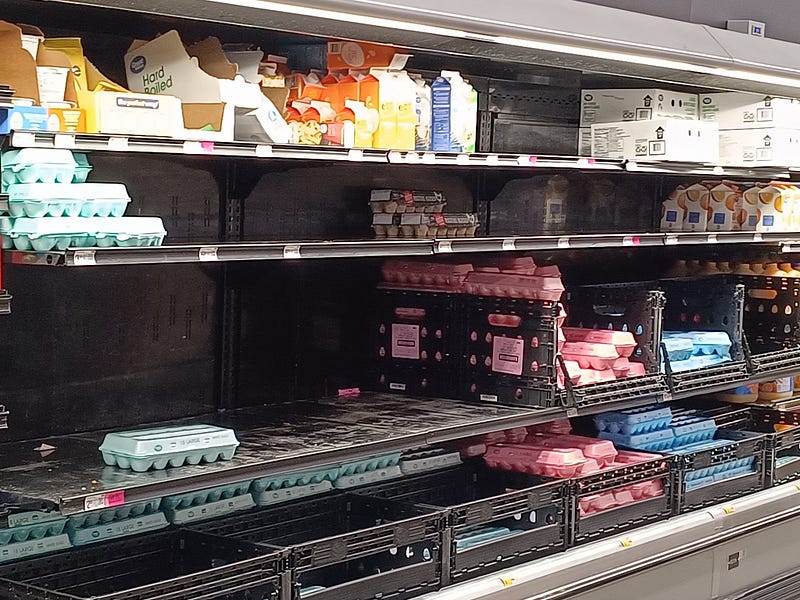
Everything else is largely the same, save for milk. Last week, a gallon of the puss filled industrial dairy product would’ve set me back $2.72. Alas, that same amount would’ve only purchased 99 out of the 128 ounces that make up a gallon. To purchase the entire gallon, I’d need to scrounge up three more quarters, a nickel, and two pennies (total of $3.52/gal). That’s an increase of almost 30% in a single week!

As concerns milk for automobiles, i.e. gasoline, my area saw a FOUR! (that’s right, not three, two, or one, but 4!) percent reduction in the per gallon price of fuel from $2.67 last week to $2.57.
Truly, we live in a golden age!
At this rate, it’d be more cost-effective to pour petroleum over your Cinnamon Toast Crunch.


- go ahead and follow the link into the void — I provided a link to demonstrate the depths of this travesty
2. Truly your forgiveness I implore, but at some point, I got the 1 in 917 billion mixed up with a 0, resulting in a figure substantially smaller for the likes of peons like me, but a mere drop in the bucket in terms of government spending. Please forgive me for not redoing all of my graphs and charts. The fact is, I was only off by a little over 1% — hardly enough to deter from the thesis of this missive.
3. As a taxpayer
4., Forgive the hyperbole. I’m not an alarmist, or doomsayer. The phrasing is to drive home the point that things are changing rapidly and I fear for the future.






Leave a reply to GAR Week 9: Balance – The Golden Age Reviewed Cancel reply